Undocumented workflows.
Teams improve or shortcut work in ways the operating model hasn't yet recognised.
Most organisations already have Shadow AI. Nineteen Point Two helps leadership teams make workplace AI adoption visible, consistent and accountable, so it can be managed with confidence.
Direct contact: ben@nineteenpointtwo.com
AI is not a strategy, it's a tool. The work is creating shared standards, manager visibility and operational consistency around the way people use it.
Shadow AI is unmanaged workplace AI adoption. It shows up as quiet changes to how work gets produced, checked, shared and explained before leaders can see the pattern.
Teams improve or shortcut work in ways the operating model hasn't yet recognised.
Similar tasks produce different standards because review expectations aren't shared.
Managers are expected to control quality without seeing how AI is being used inside the work.
Conflicting team habits become normal before the business decides what good use looks like.
The gap is practical, not theoretical. People use the tools because they help. The organisation falls behind when guidance, review points and management rhythm don't move at the same pace.
A document may exist, but teams still need practical standards for real work.
Some employees use AI confidently. Others avoid it, misuse it or lack judgement around review.
They carry the quality risk, but often lack visibility, guidance and a consistent language for AI-supported work.
Leaders can't easily see what has been acknowledged, completed, reviewed or applied.
People make fast judgement calls about information use without shared standards.
Customer-facing execution can shift before the leadership team can see where consistency is weakening.
Employees need a shared understanding of safe, useful and reviewable workplace AI use.
Different teams need role-aware examples, not generic AI literacy that stays outside the workflow.
Managers need a practical way to talk about AI-supported work, quality, review and escalation.
Leaders need to see acknowledgement, progress and completion evidence before fragmented use becomes operating risk.
WAIA is the practical workplace AI adoption system for moving from unmanaged use to clearer, safer and more consistent adoption. It combines an admin-led baseline view, practical learning, manager support, organisation guidance and evidence-led follow-up.
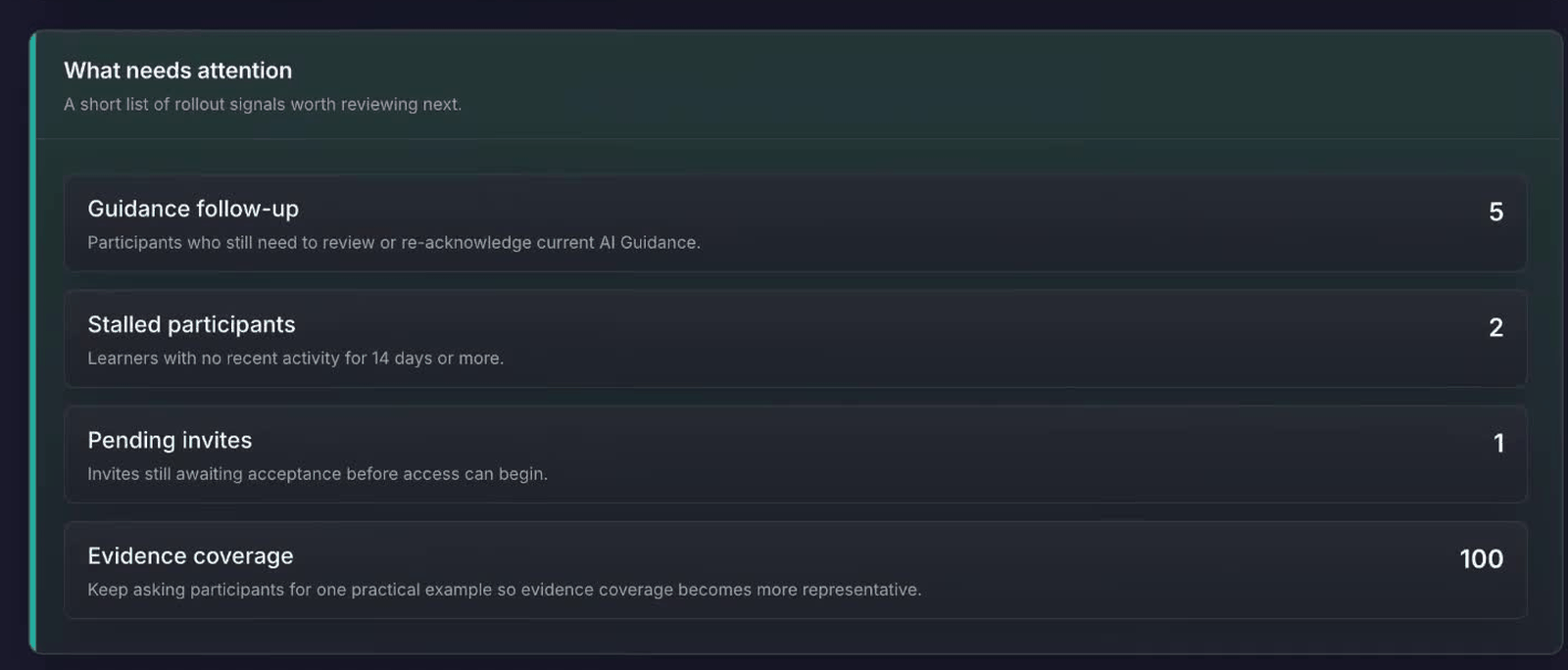
Leaders aren't buying content. They are buying confidence that teams understand the standards, managers can reinforce them and the organisation can see where adoption is creating progress, friction or follow-up needs.
Employees have practical learning, toolkit resources and guidance that connect AI use to everyday work.
Managers have clearer language for review, escalation, customer-facing quality and acceptable use.
Admins can see baseline signals, guidance acknowledgement, progress and follow-up evidence instead of guessing whether adoption is under control.
WAIA is the lead product for controlled workplace AI adoption. Outside Clarity and Revenue Review serve distinct decision moments without competing with the workplace AI adoption path.
Best when AI use is already happening and you need shared guidance, manager support, baseline visibility and evidence-led follow-up.
Best when founders, operators or small teams need an independent outside view before committing time, money or reputation.
Review the assumptions behind the number, then move to the relevant practical improvement pack if further support is useful.
Workplace AI adoption isn't controlled by tool access alone. It becomes manageable when people, process and data are visible together.
People need clear expectations for when AI helps, when it needs review and when it should stay out of the workflow.
The business needs to know where AI-supported work is used, checked, documented or avoided.
Leaders need confidence about what information is being used, how outputs are reviewed and how decisions are shaped.
Operational confidence without theatre.
The goal is controlled adoption: useful AI, clearer standards, stronger management visibility and less hidden variation across the organisation.
Move Shadow AI into visible, guided workplace behaviour.
Give managers clearer signals, language and support.
Align people around shared standards without killing useful experimentation.
Make input quality, output review and evidence visible enough to manage.
Use WAIA to understand where workplace AI adoption is creating friction, establish a baseline view, focus manager support and turn follow-up into visible evidence.
Direct contact: ben@nineteenpointtwo.com